
3 Questions to Ask When Deciding “Can’t Do” vs. “Won’t Do"
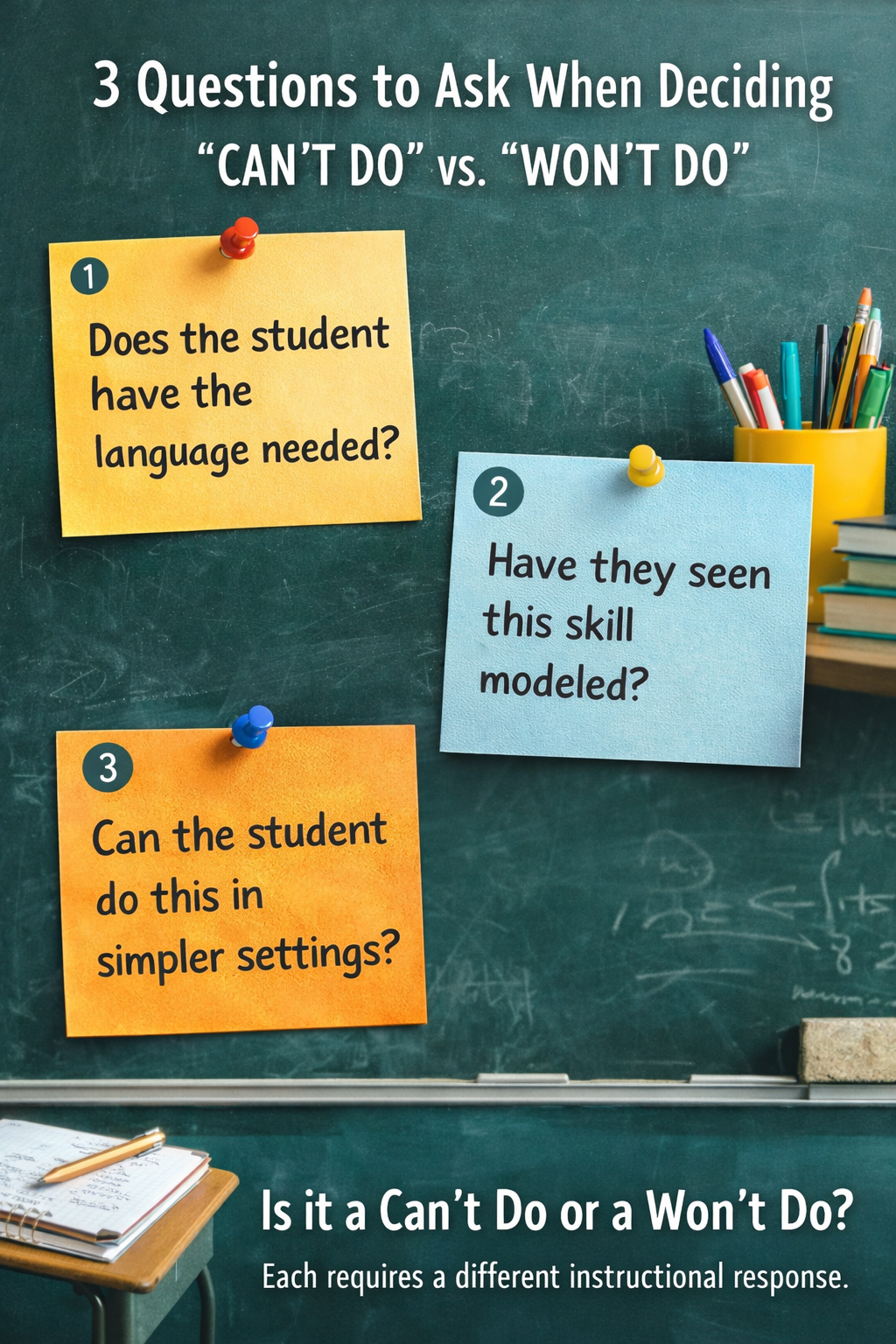
3 Questions to Ask When Deciding “Can’t Do” vs. “Won’t Do”
One of the most impactful shifts in classroom instruction is learning to tell the difference between when a student can’t do something yet and when they won’t do it. Meaning, they have the skill but aren’t applying it.
These two situations can look very similar on the surface, but they require completely different instructional responses. The good news? You don’t need new assessments or complicated tools to figure it out. You just need to ask the right questions.
1. Does the student have the academic language needed for the task?
If a student struggles to explain, respond, or participate, it’s often because the vocabulary, phrasing, or conceptual language isn’t in place.
If the language isn’t there, this is a Can’t Do.
Instructional Next Steps:
Teach the language explicitly. Model phrasing. Use sentence stems. Revisit the vocabulary in context.
This is not about motivation, it’s about access.
2. Have they seen this skill modeled clearly and recently?
Students can’t apply what they haven’t seen. If we haven’t modeled the thinking out loud, demonstrated the approach, or broken the task into visible steps, students can’t yet use the skill independently.
If modeling is missing, this is a Can’t Do.
Instructional Next Steps:
Model again slowly, in context, with real student examples. Modeling isn’t a one-time event; it’s how we normalize learning.
3. Can the student do the skill in simpler or supported contexts?
This question often reveals everything.
- If a student can do the skill with a partner but not independently → Won’t Do (yet)
- If a student can do it verbally but not in writing → Skill needs scaffolding
- If a student used to do it but isn’t now → Engagement or confidence is the barrier
- If the skill is present but inconsistent → Won’t Do (yet)
Instructional Next Steps:
Increase structure and safety. Use turn-and-talks, small group discussion, sentence starters, think time, and low-stakes rehearsal. Students need to feel safe to try before they’ll try.
Quick Reference

Why This Matters
When we respond to the real barrier, not the assumed one, instruction becomes:
- More targeted
- More supportive
- More effective
- More equitable
Students aren’t “unwilling.” They’re showing us what they feel able and ready to do. And that gives us a clear place to start building growth.
Build Shared Diagnostic Language
If your school is working to strengthen instructional clarity and student engagement, Instructional Intensity, Inc, Inc.. would love to support your team in building shared language for diagnosing performance barriers. Together, we can make teaching easier, more aligned, and more effective.
📌 Reach out here to start the conversation.
A Few of our Favorites
Stay informed with our expert articles.